Introduction
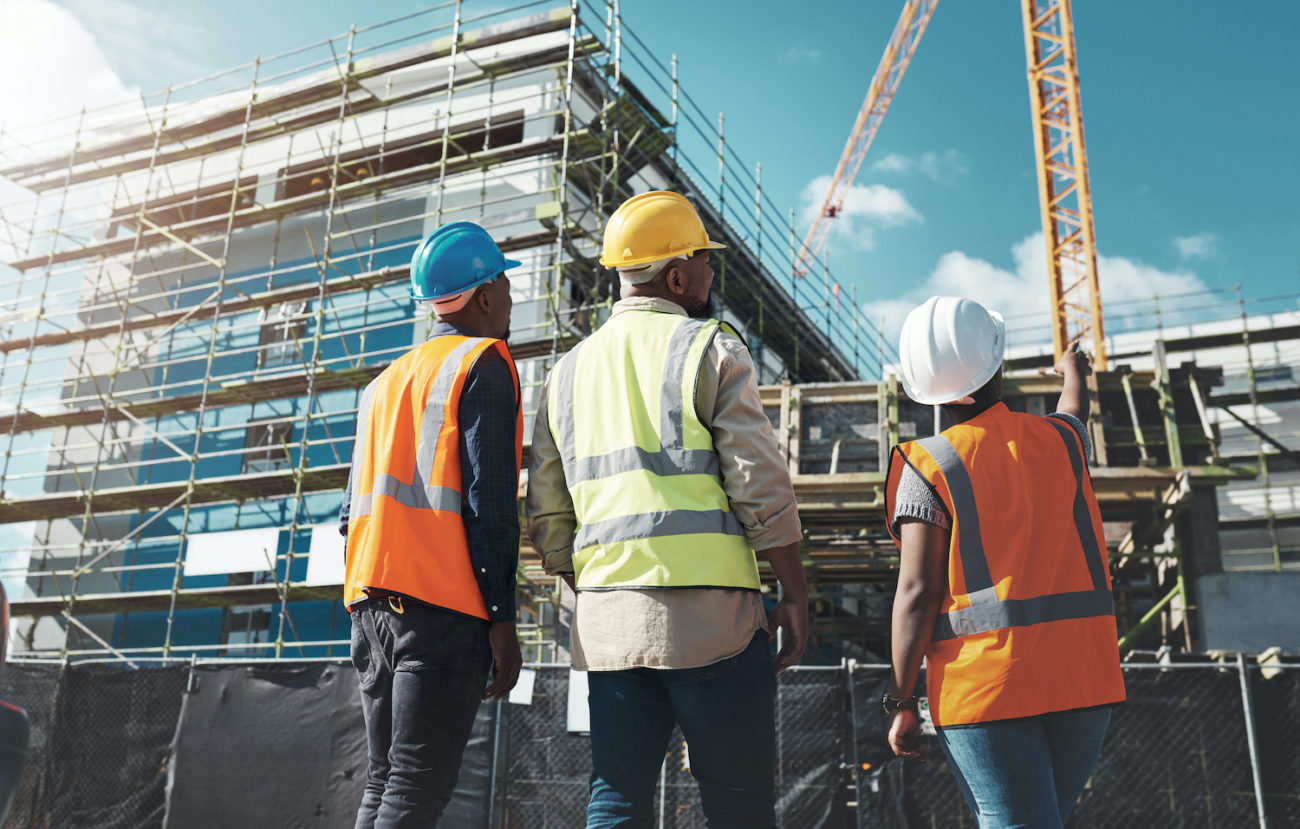
In traditional construction, discovering that a pipe is routed through the same space as a structural beam during onsite installation is a costly and time-consuming nightmare. These unforeseen interferences, or “clashes,” have long plagued the AEC industry, leading to budget overruns, project delays, and frustrating rework. Fortunately, the evolution of Building Information Modeling offers a powerful, proactive solution: BIM clash detection.
This digital process allows project teams to identify, inspect, and resolve conflicts within a 3D model long before construction begins. By creating a virtual, interference-free version of the building, stakeholders can ensure smoother execution, enhance collaboration, and deliver higher-quality projects on time and within budget.
This comprehensive guide explores the core definition of clash detection in BIM, the tangible benefits it offers, the types of clashes to look for, and the step-by-step process for effective implementation in your projects.
What is BIM Clash Detection?
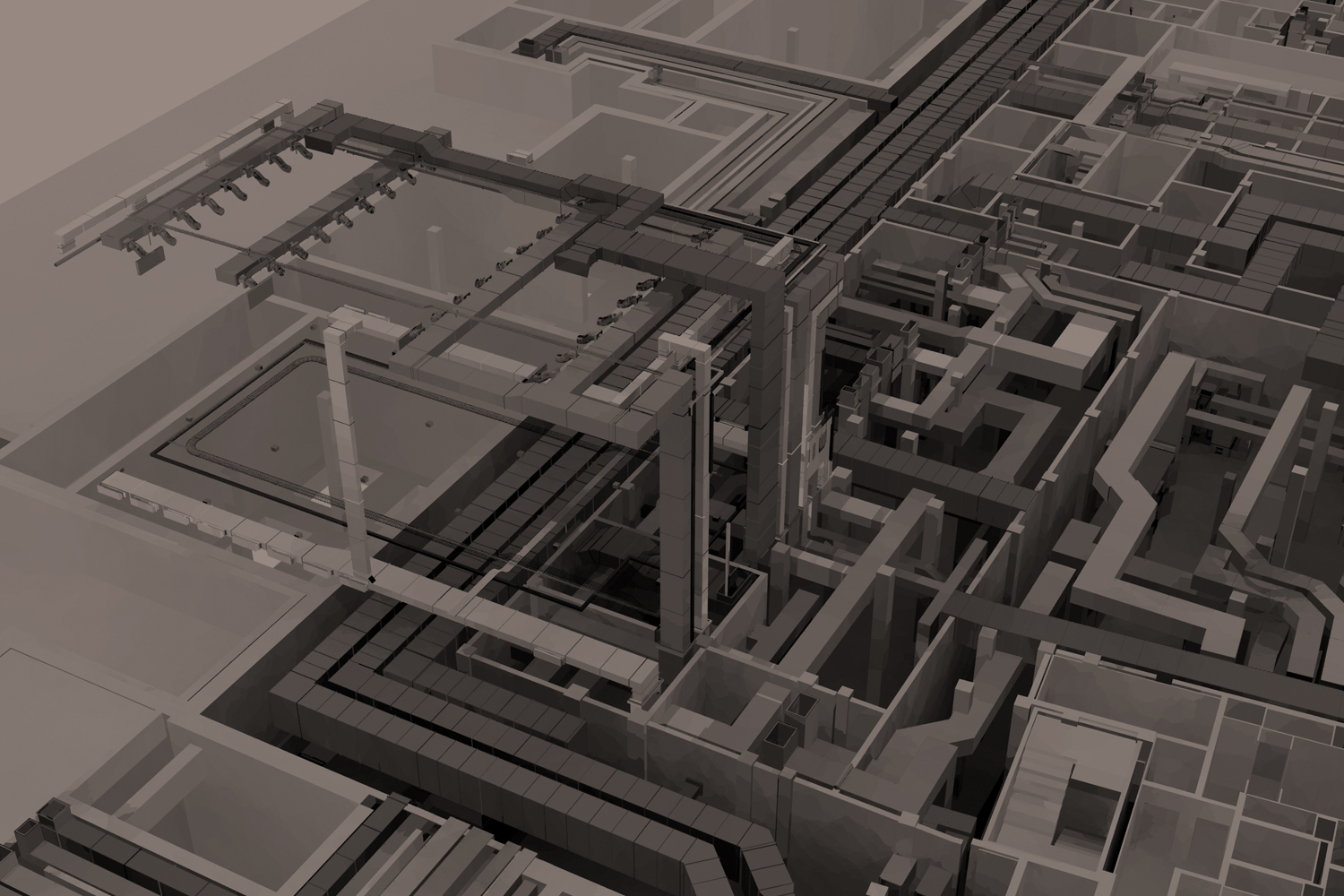
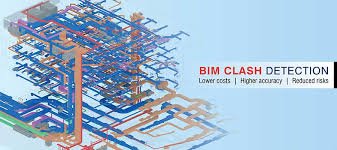
BIM clash detection is a process that identifies and addresses geometric interferences and spatial conflicts between various components in a 3D building model. A “clash” occurs when elements from one model either intersect with or violate the required buffer zone of elements from another model.
During the design phase, teams from different disciplines—such as architecture, structural engineering, and MEP—often create their models independently. When these separate models are aggregated into a single comprehensive master or federated model, there is a high risk that components will inadvertently overlap or conflict.
Specialized clash detection services use advanced software to analyze this federated model and pinpoint the exact location of these conflicts. The software flags every instance where two objects improperly intersect or violate predefined spatial requirements. This proactive quality control method transforms coordination from a reactive, onsite problem into a manageable, digital task during the pre-construction phase.
Building conflict reporting becomes a structured, systematic process rather than a chaotic field issue. ENGISOFT’s approach to BIM clash detection plays a significant role in determining constructability issues before the commencement of building construction, saving time and resources throughout the project lifecycle.
Key Differences: Traditional vs. BIM Clash Detection
The shift from traditional 2D-based methods to a BIM-centric workflow represents a fundamental change from a reactive to a proactive approach in managing project interferences:
Traditional Clash Detection (Reactive Approach):
- Clashes are discovered manually on-site during construction, leading to immediate disruptions
- Leads to high rework costs, material waste, and significant budget overruns
- Prone to frequent and lengthy delays as teams stop work to resolve unexpected conflicts
- Teams work in isolated silos with 2D drawings, often leading to misalignment and miscommunication
- Errors are common due to misaligned 2D drawings, outdated information, and human oversight
- Problems are solved reactively after they have already caused delays and added costs
BIM Clash Detection (Proactive Approach):
- Clashes are identified digitally in a 3D model during the pre-construction phase, preventing on-site issues
- Dramatically reduces costs associated with rework, RFIs, and change orders through early resolution
- Facilitates faster project delivery and more reliable schedules by ensuring trades are well-coordinated
- Fosters a collaborative environment where architects, engineers, and contractors work in sync within a shared model
- 3D models ensure precise geometric alignment, significantly reducing installation errors
- Decisions are made proactively during the planning phase, allowing for optimized solutions and smooth execution
Key Benefits of BIM Clash Detection
Higher Accuracy in Construction Drawings and Installation
A clash-free 3D model serves as a verified foundation for all project documentation. When drawings—plans, sections, and elevations—are extracted from a coordinated model, they are inherently more accurate and consistent. This eliminates the ambiguity and conflicting information often found in 2D-based workflows, providing construction teams with reliable documents that lead to precise installations.
Fewer Iterations During Onsite Installation
The primary benefit of BIM clash detection is the significant reduction in rework. Identifying conflicts in a virtual environment is infinitely cheaper and faster than discovering them onsite. This proactive approach minimizes unexpected change orders, saves on labor and material costs associated with demolition and re-installation, and keeps the project on schedule.
Enhanced Interdisciplinary Coordination and Collaboration
Building conflict reporting is a powerful catalyst for collaboration. The process necessitates that architects, structural engineers, MEP specialists, and fabricators share their models and communicate effectively to resolve conflicts. ENGISOFT’s MEP coordination services ensure that all technical silos are aligned with the overarching building design.
By making models accessible on a Common Data Environment (CDE) or using real-time collaboration platforms, inter-trade communication among all construction stakeholders is drastically improved. Regular BIM coordination meetings become highly focused and productive forums for problem-solving, fostering a more integrated and cooperative project environment.
Higher Project Efficiency with Interference-Free 3D BIM Models
An interference-free 3D model streamlines every subsequent phase of the project. From design validation and cost estimation to fabrication and construction sequencing, all processes are based on a reliable and coordinated digital asset. This leads to fewer requests for information (RFIs), smoother workflows, and a more predictable and efficient project delivery.
Lower Material Costs with Precise BOQs and BOMs
With a fully coordinated model, quantity takeoffs for Bills of Quantities (BOQs) and Bills of Materials (BOMs) are far more accurate. This capability ensures that materials are ordered in the correct quantities, reducing waste from over-ordering and avoiding delays caused by shortages. Precise material management directly contributes to a healthier project budget.
Reduced Onsite Risks Through 360-Degree Visualization
Visualizing the entire project in a detailed 3D model offers a comprehensive, 360-degree perspective. This virtual simulation allows teams to meticulously examine complex system interfaces, spatial constraints, and the planned sequence of installation before any physical work commences. By simulating the construction process, potential clashes during installation, constructability issues, and safety hazards can be proactively identified.
Types of Clashes in BIM
There are several types of clashes that can occur in architectural, structural, and MEP layouts. Understanding these helps in implementing effective clash detection services.
Hard Clash
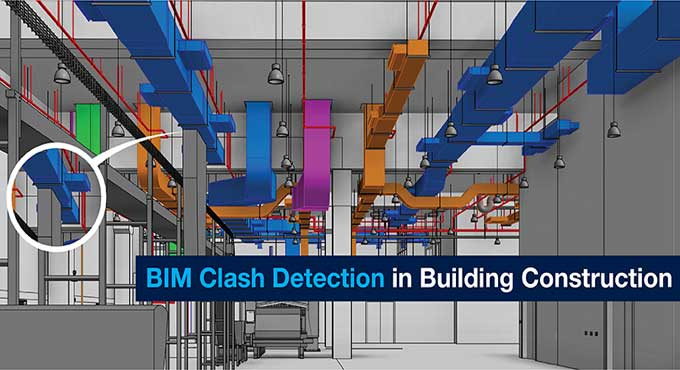
A hard clash occurs when two or more components, elements, or systems physically intersect or occupy the same space in the model. While these are often the easiest clashes for software to identify, they can be incredibly costly if missed, leading to significant onsite rework.
Example: A duct running directly through a concrete column, a ductwork segment intersecting with a structural steel beam, or an electrical conduit placed inside a wall stud.
Soft Clash (Clearance Clash)
A soft clash, sometimes called a clearance clash, occurs when a building component has not been given enough buffer space to operate safely and effectively. These clashes don’t involve a direct physical intersection, but rather a violation of the required geometric or spatial tolerances needed for installation, maintenance, or safety compliance.
Example: An air conditioning unit installed without enough surrounding space for a technician to perform routine maintenance. Another critical safety example is a high-voltage wire running too close to a plumbing line.
Workflow Clash (4D Clash)
Also known as a 4D clash, a workflow clash involves a conflict in the project timeline related to scheduling, material delivery, and site logistics. These clashes can hinder jobsite productivity and cause significant delays.
Example: Scheduling the installation of electrical conduits at the same time as pouring a concrete slab in the same area would result in a work stoppage.
The Step-by-Step BIM Clash Detection Process
A successful clash detection strategy is a systematic, iterative process, not a one-time event:
1. Model Preparation and Aggregation
The process begins by collecting the latest 3D models from all design disciplines (e.g., Revit files for architecture and MEP, Tekla files for structure). These models are then aggregated into a single composite model. Establishing a common coordinate system is critical at this stage to ensure all models align correctly.
2. Preliminary Checks and Quality Assurance
Before running automated tests, it’s good practice to perform visual inspections of the federated model to catch any glaring errors. Incomplete or poorly modeled elements can lead to false positives or missed clashes.
3. Running Automated Clash Detection Tests
This is the core of the technical process. The steps include:
- Select Models for Testing: Choose the specific models or groups of elements to be tested against each other
- Set Clash Rules and Tolerances: Define test parameters, including the type of clash (Hard, Soft/Clearance) and the tolerance
- Run the Test: Name the test for easy identification and run the clash detection process
4. Identifying, Categorizing, and Prioritizing Results
The initial test run can generate a long list of clashes. The next crucial step is to analyze and manage this data:
- Review and Group: Each clash is reviewed and grouped by status
- Prioritize: Clashes are prioritized based on their severity
- Generate Reports: Detailed clash reports are exported with screenshots, element IDs, and grid locations
5. Assigning and Tracking Clash Resolution
The clash report is distributed, and each conflict is assigned to the relevant team member(s) for resolution. Modern collaboration platforms allow for clear communication, status tracking, and accountability.
6. Re-running Checks and Final Model Update
Once responsible parties have modified their native models, the updated models are re-exported to the federated model. Clash detection tests are run again to verify that conflicts have been successfully resolved. This iterative cycle continues until an interference-free model is achieved.
Essential Software for BIM Clash Detection
Selecting the right software is crucial for an effective clash detection workflow. Several platforms stand out for their capabilities:
Autodesk Navisworks Manage: The industry standard for BIM clash detection, offering the ability to aggregate models from dozens of different file formats into a single, navigable environment.
Autodesk Revit: As a primary BIM authoring platform, Revit includes a built-in “Interference Check” tool, though it is not as comprehensive as Navisworks.
Solibri Model Checker: For teams prioritizing deep, rule-based analysis, Solibri enables checks for code compliance, model quality, accessibility standards, and project-specific requirements.
Revizto: As an Integrated Collaboration Platform, Revizto excels in embedding clash detection within a real-time issue-tracking environment.
BIMcollab Cloud: Specializes in clash management and coordination, with the ability to connect directly with major BIM tools.
Trimble Connect: Positioned as a Common Data Environment (CDE), Trimble Connect facilitates collaboration through strong IFC interoperability.
Why Choose ENGISOFT for Your BIM Clash Detection Needs
ENGISOFT has established itself as a leading provider of BIM coordination services and clash detection services across the AEC industry. Our approach combines cutting-edge technology with deep industry expertise:
Comprehensive Coordination: Our MEP coordination services ensure that mechanical, electrical, plumbing, and structural systems work in perfect harmony, eliminating conflicts before they reach the construction site.
Advanced BIM Modeling: Our team of expert architects and engineers create high-quality BIM models that form the foundation for effective clash detection and building conflict reporting.
Experienced Team: With years of experience in BIM consulting services, we understand the complexities of interdisciplinary coordination and apply best practices to identify and flag potential issues early.
Proactive Problem Solving: We deliver clash-free models and BIM coordination strategies tailored to your specific project requirements, minimizing risks and reducing costly rework.
End-to-End Support: From BIM implementation services through project completion, we provide the expertise and support needed to ensure successful coordination and clash-free construction.
Conclusion
BIM clash detection has become a fundamental practice in modern construction management. By implementing systematic building conflict reporting and MEP coordination processes, projects achieve significant cost savings, maintain schedules, improve safety, and deliver higher-quality buildings.
The benefits of clash detection extend far beyond identifying spatial conflicts—it creates a structured framework for collaboration that improves communication and decision-making throughout the design and construction process. Whether managing a small renovation or a large infrastructure project, clash detection represents an essential investment in project success.
ENGISOFT’s comprehensive BIM coordination services, including clash detection services, MEP coordination, and BIM consulting services, position your projects for success. By leveraging our expertise in BIM implementation and our commitment to delivering interference-free models, your organization will consistently deliver projects more efficiently and cost-effectively.
Partner with ENGISOFT today and transform your project coordination approach. Contact us to learn how our BIM services can eliminate conflicts, reduce costs, and accelerate your project timeline..